Monday, May 21, 2018

Queer Analysis

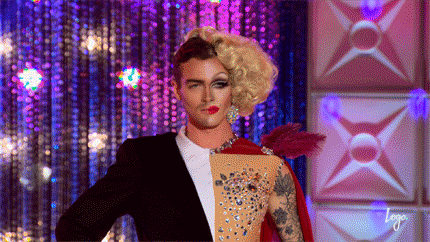
When considering gender or applying a queer analysis to shows, the first thing that comes to mind is RuPaul's Drag Race. Known as a staple in gay culture, RuPaul's Drag Race serves as a progressive form of media that has been slowly seeping into the heteronormative culture that is today's society. Jumping from Logo, a predominantly gay television station, to VH1, RuPaul has succeeded at transcending the social norm that constantly keep homosexuals oppressed and contained in a corner that's still in media's eye but far enough away that it can be forgotten about or avoided. Since the popularity of the show has risen, so has visibility for the LGBTQ community, although mainly focusing on the Gay part of acronym. It's important to note the visibility of all other forms of LGBTQ members because as gay men grow to the center of the light, bisexuals and lesbians fade into the background. I withhold transgendered people from this form of exclusion because, more often than not, they are found in RuPaul's Drag Race as transitioning contestants.
The show is something like the worlds toughest competition. Contestants, drag queens (men who dress as women), have to sing, dance, act, and construct their own outfits to compete for the title of America's Next Drag Superstar. This is done through numerous challenges that require comedy, camp, and a quick wit. This show is important because, as gay men dressing as women and embodying gender ambiguity, the show demonstrates a flippancy towards gender construction. The comedy is achieved through the recognition of gender stereotyping, heteronormativity, and gender performance. The show itself is very comfortable with poking fun at societies constructs and what is considered a norm. With contestants often winning for thinking outside of the box, transformative ideas that push boundaries are often prided and rewarded, making going against the grain of society commendable. What's rather interesting about this show is that it explores sexual othering in a new way. Rather than stigmatizing homosexuality, RuPaul's Drag Race does the reverse and stigmatizes heterosexuality, almost completely ignoring it in the show, or poking fun at it.
To touch back on what I mentioned earlier, what makes this show so incredible can also be it's downfall. Yes, any and all exposure of the LGBTQ community is good, but the loss of bisexual acknowledgment or any lesbian representation can be damaging to the already oppressed sexual deviations. It's interesting to approach this with a feminist perspective: should we be surprised that there is homosexual male representation and no lesbian representation? Have women been pushed into the back seat of LGBTQ representation in media? It's sad to recognize that sex discrimination still plays such a major roll in a progressive show, but it's important to make these distinctions so that even more progress can be made. Hopefully, the next thing we seen in media that boasts LGBTQ visibility is something like drag kings competing.RuPaul's Drag Race Recap: Dancing Queens | RuPaul's Drag Race

Appropriation vs. Appreciation Part II

When considering cultural appropriation versus appreciation the main distinction is knowledge and respect. When someone takes something from a culture that isn't theirs and exoticizes it, exploiting whatever it is for their own personal benefit, then it's appropriating. In contrast, when someone adopts something from another culture and knows the history behind whatever it is that they're borrowing, paying it respect, then it can be considered appreciation. In a way, cultural appropriation is synonymous with assimilation: something is being stripped of it's historical significance and integrated into a different culture.
A popular example and debate between appropriation and appreciation is last year's exhibition, "Treasures from the Wreck of the Unbelievable" where Damien Hirst displayed a huge golden sculpture of a head that was seen as being almost identical, if not very similar, to African artists who produced such heads long before this exhibit. Hirst, a white artist, was criticized for appropriating the Nigerian art, having things said about him that caution the eradication of the historically significant African heads. The idea was posed that now, since Hirst has created such a piece and is able to display it on such a large platform, that the original African artist's prior workings will be forgotten, having only Hirst's creations remembered and idolized. Something to be considered is that Hirst pays tribute to the original Nigerian art, showcasing the inspiration behind his piece in the description of the golden head, siting the sources he used. Although many people were and are upset by Hirst's creation, it's an interesting topic to discuss. If he has his African-influenced art in an exhibit and pays respect to the original, is it appropriation or appreciation? Could it be possible that Hirst is trying to use his incredible platform to inform others on the art that is less visible and has inspired him? Or is Hirst an entitled colonizer that wants to showcase exotic pieces for maximum profit? 
The line between appreciation and appropriation is an incredibly thin one, and I'm still unsure of where it should be drawn in this example that I've described. When I consider the difference between the two, what often comes to mind is the intention. Sure, everyone can like something, but are you adopting/borrowing something from another culture to profit off of it, or to inform others? When it comes to Damien Hirst I'm unsure, but it's important to keep in mind the concept of privilege. Hirst, being a white man, experiences privilege in it's most primitive form. I think what really serves as the telling sign of appropriation is if a dominant race/culture is borrowing or adopting something from a less domineering and oppressed minority group. This is a topic that I constantly discuss with my friends and family because it's interesting to see so many different view-points and if there's any innate bias in the discussion. Interpretation plays a huge role in determining how someone perceives such an incident. In this specific case, I'm not sure how to interpret what Hirst did, but it's definitely something worth considering from both perspectives. Image result for african head art sculpture

Tuesday, May 8, 2018

Appropriation vs. Appreciation

When considering cultural appropriation versus appreciation the main distinction is knowledge and respect. When someone takes something from a culture that isn't theirs and exoticizes it, exploiting whatever it is for their own personal benefit, then it's appropriating. In contrast, when someone adopts something from another culture and knows the history behind whatever it is that they're borrowing, paying it respect, then it can be considered appreciation. In a way, cultural appropriation is synonymous with assimilation: something is being stripped of it's historical significance and integrated into a different culture.

Tuesday, April 24, 2018

Tropes - Adrenaline Makeover

The adrenaline makeover is something that women often experience in films or shows when entering into action. When this occurs it's meant to expose the woman's attractiveness, as if it was lost before a man, or action, was present in the woman's life. This kind of transition is not only sexist for only occurring to women, but also a sort of stereotype, saying that women cannot be the way they are, they must undergo a makeover in order to achieve social attractiveness and be accepted. A film that comes to mind when thinking about the adrenaline makeover is Hunger Games. After Katniss volunteers as tribute, she is taken to a dark and cold setting where she lies on her back and is made over. He hair is trimmed, she is waxed, and she is scrubbed down. Once this happens, she is viewed by the Capital as beautiful, capable, admirable, and courageous. This trope being presented in major films plays into the gender stereotypes that plague our society. I do think that this film features a strong, mostly independent female protagonist, but the fact that she has to undergo a makeover subconsciously teaches viewers that in order to succeed and be taken seriously, you have to look attractive. Our society thrives on this structure, convincing female viewers that looks aren't just important, but vital to survival. 

Wednesday, April 18, 2018

Vogue April 2008

Exclusion: In this Vogue cover photo we see only two people. One is white and one is black. Since there are only two people it's hard to think in terms of exclusion because it seems like Vogue is trying to be inclusive, but there definitely is a lack of non-white representation and LGBTQ+ representation. 
Stereotyping: I think that in this photo there is some stereotyping. We see a black man as a basketball player and a skinny white woman in high heels and a sheer dress. Yes, the basketball player is an actual basketball star, but to only represent him as that stereotypes him. The woman in the photo is not wearing something that reveals a hobby or profession, so why is the man? I also think the fact that the man looks very aggressive can be seen as a stereotype as well. Alongside that, the woman, being skinny, white, and blonde feeds into a stereotype that all white blondes that are skinny are happy. 
Assimilation: I view this image as a direct example of assimilation. The fact that Vogue has used a black man, in basketball attire nonetheless, makes me think that they only wanted to take the "popular" aspect and face of what society recognizes from this man to turn a profit for their magazine.  
Tokenism: I think that Vogue is definitely using the the one non-white person as a token because it's "inclusive". 
Ideology of difference: Building off of the stereotype that's at hand, the black man dressed in basketball attire, we can see how the ideology of difference comes into play. Vogue utilizing this man's identity to contrast with the woman's is like a form of consumption for magazine buyers. We see something new, something different, something aggressive, and we put it on a magazine because it sells because it's exciting and unique, paying no respect to a culture's background. 
Othering: Placing a black, somewhat enraged-looking, larger man next to a petite white woman gives off hints of othering because it looks as if we are supposed to compare the differences. We see skinny, white blondes in media everywhere, but having her next to this man send a message that tells us to recognize what's new or what we haven't seen much of in media. 
Exoticism: Much like National Geographic, I think that this image is a form of exoticism; Vogue using this man on their cover and trying to show his "rage" and basketball prowess is seen as "animalistic" next to the woman who is carefree and smiling.

Tuesday, April 17, 2018

How to Get Away with Murder


When thinking about How to Get Away with Murder, I'm constantly reminded of the fact that the show is incredibly inclusive compared to all other shows that I see in media today. Starting with exclusion, it's upsetting to realize what the show has omitted. It lacks Asian representation and also doesn't feature disabled people. It's hard to recognize stereotyping within the show because I think a lot of what's demonstrated is either true or a variation of assimilation. Some characters experience assimilation by being represented as middle or upper class while also being a minority. The lead woman, played by Viola Davis, is an incredible lawyer who makes good money and lives a prestigious lifestyle. I struggle with thinking that this is assimilation because there are occasional references to her past that express financial hardship of growing up in the South, but these episodes are not frequent and there's a lack of racism that's acknowledged in the show. The same can be said for the Latin woman in the show; she comes from a rich background and faces minimal adversity when it comes to her culture or identity. I don't think that there's much tokenism happening within the show. The only thing that I can think of is how Viola Davis' character is the only bi-sexual that's been represented, but even then, the show only exposed us to her bi-sexual lifestyle in about three episodes. I wouldn't say that the show features othering. I also don't think the show features exoticism. I am, however, unsure about the ideology of difference. We aren't exposed to a lot of the black culture within this show and because of this, it's hard to know if the show is trying to give us a different culture to consume. I think the fact that the lead woman is black gives audiences a sense of inclusion that's pleasurable, but not in the same way that the ideology of difference is defined.

Tuesday, April 3, 2018

Midterm Question


Satirizes management/owners of means of production: Berns shrugging off the struggling window worker, Berns having a huge bird zoo in his house and a giant TV, having chained up monkeys doing work for him, Berns not knowing Homer, a worker that he's had numerous interactions with, Berns having an incredibly high and pointless security system, and Berns thinking that Homer, a dim worker, is highly intelligent and sophisticated. 
Satirizes workers/unions: Workers get a cookie on St. Patricks day (seen as greedy and pointless), workers seen as dumb and simple when swapping dental plan for a keg of beer, workers jobs depicted as easy with Berns dancing on the control panel and running the factory, Homer (union leader) misinterpreting and not understanding anything that Berns says or offers, Homer getting excited about the idea of being a crooked union leader that's hungry for money. 

This episode normalized the prevailing ideology of capitalism because the ending of the episode finishes, and is resolved, with a small easy deal made between Homer and Berns, restoring power back into the city without any control being taken away from Berns. The episode also normalizes capitalism when, in the flashback, workers are persecuted for taking something that the company has incredible amounts of. Lastly, capitalism is normalized through the movie that was being watched in the beginning of the episode by Bart and Homer when Bart says, "That is one evil dude" in regards to the upper-class villain, and Homer responds, "It's just a movie, son. There's nobody that evil in real life." In contrast, the episode challenges the prevailing ideology of capitalism by demonstrating Homer's run as a union leader as a total success when he wins back dental care from Berns. Capitalism is again challenged when we see Berns' very "protected" security system fail to keep out a stray dog, making us see the system as obsolete and easily encroached upon. Finally, capitalism is challenged through the strike that is held by the union workers, suggesting that if you fight against the system for long enough, you can win whatever it is that you're fighting for.